A Complete Guide to Nouns for Students Understanding Types Rules and Examples

Nouns are the building blocks of every sentence we speak or write. Without nouns, it would be hard to talk about people, places, things, or ideas. Whether you are writing a story, answering questions in class, or chatting with friends, nouns help you name everything around you. This guide will help you understand what nouns are, why they matter, and how to use them correctly. You will also learn about different types of nouns, important rules, and examples to practice.
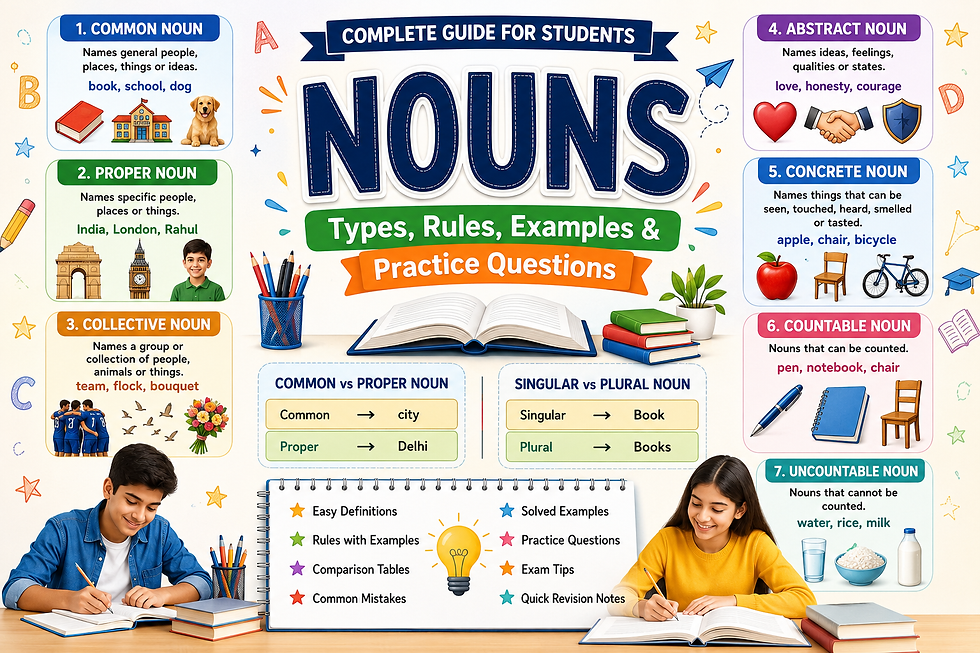
What Is a Noun?
A noun is a word that names a person, place, thing, or idea. It tells us what we are talking about in a sentence.
Simple explanation:
A noun is the name of something you can see, touch, or think about.
Basic sentence formula:
Sentence = Noun + Verb + Other Words
Examples:
The dog runs fast.
Sara reads a book.
The school is big.
Happiness is important.
In each sentence, the noun tells us who or what the sentence is about.
Why Are Nouns Important?
Nouns are important because every sentence needs a subject or object to make sense. Without nouns, we cannot name the things we talk about. They help us describe the world and share ideas clearly.
For example:
"The cat sleeps." (The noun is cat.)
"I like ice cream." (The noun is ice cream.)
Without nouns, these sentences would be incomplete and confusing.
Types of Nouns
Nouns come in different types. Each type has its own rules and uses. Let’s explore them one by one.
1. Common Nouns
Meaning:
Common nouns name general things, people, or places. They are not specific names.
Rules:
They do not start with a capital letter unless they begin a sentence.
They can be singular or plural.
Examples:
boy, city, school, dog, book
Sentences:
The boy is playing.
I live in a city.
She has a dog.
2. Proper Nouns
Meaning:
Proper nouns name specific people, places, or things. They always start with a capital letter.
Examples:
People’s names: John, Maria
Cities: London, New York
Countries: India, Canada
Days: Monday, Friday
Months: January, July
Sentences:
Maria is my friend.
We visited Paris last summer.
Monday is the first day of the week.
3. Collective Nouns
Meaning:
Collective nouns name a group of people, animals, or things as one unit.
Examples:
Team
Class
Family
Herd (group of animals)
Crowd
Fleet (group of ships)
Bouquet (group of flowers)
Explanation:
A team plays together.
The class is studying.
A herd of cows is grazing.
4. Abstract Nouns
Meaning:
Abstract nouns name feelings, qualities, or ideas that you cannot see or touch.
Examples:
Love
Honesty
Courage
Happiness
Freedom
Kindness
Sentences:
Love is powerful.
She showed great courage.
Happiness comes from within.
5. Concrete Nouns
Meaning:
Concrete nouns name things that you can see, touch, hear, smell, or taste.
Examples:
Apple
Music
Flower
Dog
Water
Sentences:
The apple is red.
I hear music.
The flower smells nice.
6. Countable Nouns
Meaning:
Countable nouns are things you can count. They have singular and plural forms.
Examples:
One book, two books
One car, three cars
Sentences:
I have one pen.
She bought five apples.
7. Uncountable Nouns
Meaning:
Uncountable nouns are things you cannot count because they are seen as a whole or mass.
Examples:
Water
Sugar
Milk
Air
Rice
Advice
Information
Explanation:
You cannot say "two waters" or "three sugars" unless you mean types or containers. These nouns usually do not have a plural form.
Sentences:
I need some water.
She gave me good advice.
Singular and Plural Nouns
Nouns can be singular (one) or plural (more than one).
Regular Plurals
Add -s or -es to make plurals.
Book → Books
Box → Boxes
Car → Cars
Irregular Plurals
Some nouns change completely in plural form.
Singular | Plural |
Child | Children |
Man | Men |
Mouse | Mice |
Tooth | Teeth |
Foot | Feet |
Woman | Women |
Goose | Geese |
Sentences:
The child is playing. The children are playing.
The man is tall. The men are tall.
Possessive Nouns
Possessive nouns show ownership or belonging.
Examples:
Boy’s book (the book belongs to the boy)
Girls’ school (the school belongs to the girls)
Teacher’s desk
Children’s park
Rules:
Add ’s for singular nouns: boy → boy’s
Add ’ for plural nouns ending in s: girls → girls’
For plural nouns not ending in s, add ’s: children → children’s
Gender of Nouns
Nouns can show gender, which means whether they refer to males, females, or neither.
Masculine: boy, king, actor
Feminine: girl, queen, actress
Common: teacher, doctor, student (can be male or female)
Neuter: table, chair, book (no gender)
Examples:
The king rules the kingdom.
The queen wears a crown.
The teacher is kind.
Nouns in Daily Life
You use nouns every day in many places:
School: student, teacher, classroom
Home: kitchen, bed, family
Shopping: shop, money, bag
Sports: player, ball, team
Mobile phone: call, message, app
Internet: website, email, password
Using nouns correctly helps you communicate clearly in all these situations.

Common Mistakes with Nouns
Some nouns confuse students because they do not have plural forms or are used incorrectly.
Advice is uncountable. Do not say "advices."
Information is uncountable. Do not say "informations."
Furniture is uncountable. Do not say "furnitures."
Correct:
She gave me good advice.
I need more information.
The furniture is new.
Nouns are everywhere in language. Knowing how to use them well helps you write and speak clearly. Practice by identifying nouns in your reading and try making your own sentences with different types of nouns. This will make your English stronger and more interesting. Keep exploring nouns, and you will find it easier to express your thoughts every day.


Comments